7 Cultural Considerations
It’s a Small World After All
I always teach my students that it’s horrible writing to use a sentence that reads “according to the Merriam-Webster Dictionary…” but sometimes it’s OK to be horrible.
According to the Merriam-Webster Dictionary, the word ‘culture’ can be defined as…
the beliefs, customs, arts, etc. of a particular social group, place, or time
OR
the set of shared attitudes, values, goals, and practices that characterizes an institution or organization
Either (or both) definitions work for what we’re going to be looking at: the various ways in which professional and technical writers have to take culture into consideration when they think about their audience(s). It’s always been important to consider culture in any workplace or professional communication but it’s more important now than ever, as it really is a small world. From 2014 to 2024, according to data from the U.S Bureau of Labor Statistics, the percentage of the US workforce that identified as Hispanic rose 30%, African American rose 17%, and all other/multiracial groups rose 34%. Those numbers are expected to continue to increase over the next ten years, even as the percentage of white workers decreases. Diversity is a thing and it’s not going anywhere.
What that means, in practical terms, is that the audience you may eventually be trying to reach with your professional/technical communications is, increasingly, going to be made up of people from diverse cultural, ethnic, and religious backgrounds. And if you want to communicate with those people effectively, that’s something you’re going to have to think about.
All of which raises the obvious question: what is culture?
Race is Just the Tip of the Iceberg
That’s not just a figure of speech.
In 1976, Edward T. Hall described what he called “the cultural iceberg.” Hall used an iceberg as his analogy because it, like culture, is broken up into two parts – what we see on the surface (about 10%) and what lies below (the other 90%.) In Hall’s terms, most of what makes up a ‘culture’ are the things we can’t readily see just by looking.
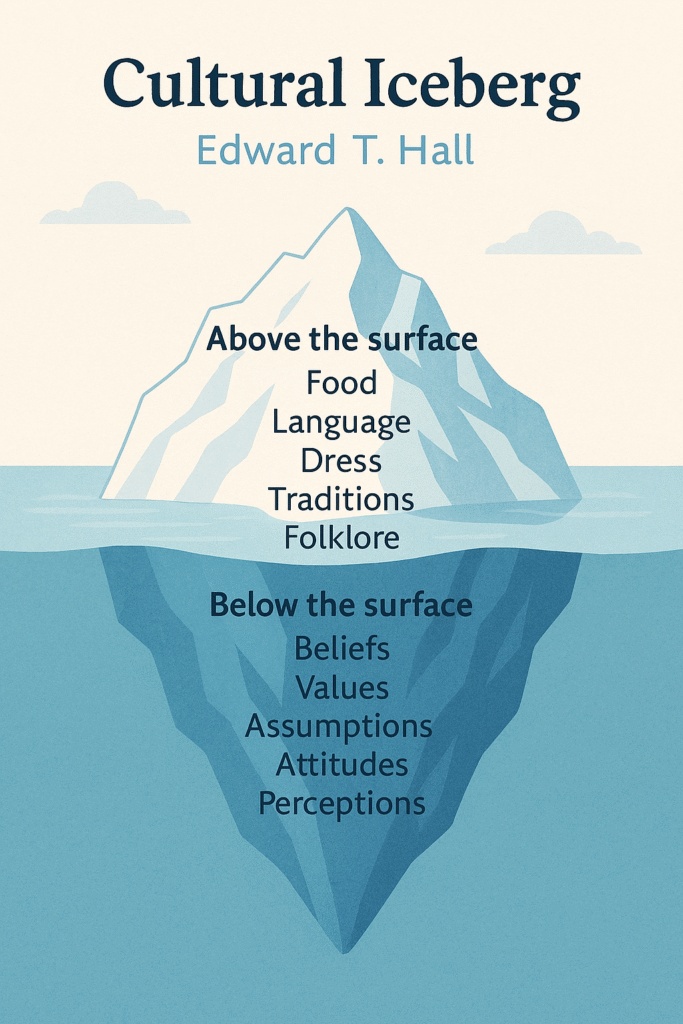
There are a lot of things we can easily observe about any given culture: the foods they eat, the ways in which they dress, the language(s) they speak. Those are all important. But what lies under the surface is often more important: beliefs, values, morals, attitudes. It’s those parts of a culture that usually most strongly influence behavior, reactions, and decision making.
Where We Mess Up
The most common – and easiest – way for someone to make a mistake in trying to communicate with a multicultural audience (or an audience that is entirely one different culture) is by ignoring what know in favor of what we’re comfortable with.
What we know: Cultures all have their own rules, behaviors, and norms
What we’re comfortable with: Our rules, behaviors, and norms
And so… we attempt to apply our rules, behaviors, and norms to everyone else, either intentionally or through ignorance.
In this video, Professor Jeanne Brett relates a brief story that highlights the problems with applying our own cultural standards to everyone else and the benefits of considering the culture of others in your professional relationships.
As you compose/create professional documents in this course, always keep in mind the audiences you might be interacting with and what cultural considerations you should be giving in order to give yourself the best chance at effectively reaching your audience.
TL;DR
The American workforce is increasingly multicultural and will only get more so over the coming years. To be effective professional communicators, it’s important to remember:
- Culture is mostly made up of things we can’t see
- We should not try to apply our own cultural standards onto others
- Understanding the culture of your audience can lead to more successful interactions for both you and them